Home | Alpha? Beta? | Contact

Mistakes Were Made - Work in Progress -

(Alpha v1.0.1)

Where Legends Gather

Critiques of the Free Speech Debate at UoT

Moderator: Moran
Free Speech Advocates: Peterson
Anti-Free Speech Advocates: Bryson, Cossman

[Insert intro here. I don't care. I always wrote the essay before the thesis, you know. I looked at the evidence first. :^)]

Toward the end of Peterson's opening statement, [clip] he said "I just sat in my office at home and threw up a couple of amateurish videos more or less attempting to articulate my feelings about a couple of policies."

At no point in his videos did Peterson claim to be presenting any information as an expert in the field, nor as a scholarly paper. Yet, University of Toronto student groups falsely claimed it absurd that he "[suggested] that these comments add value to classroom discussion." [clip]

This brings us to Bryson's opening quote, words suitable for the spirit of democracy, open dialogue, and debate: "I do not want to be here. I do not want to dignify this man and his ideas in public debate." [clip] She continued and said "If you only hear this, know that I am unwavering in my belief that the fundamental rights and the humanity of trans and non-binary people are not up for debate." But, love, that's not what this debate was about; it was about potentially abusable and restrictive policies regarding pronouns. Are you sure you were in the correct debate hall? No one on this panel suggested anything close to taking away the fundamental human rights or the humanity from anyone.

Bryson continued "...Of crucial import to my argument today is that this is a relationship structured not on juridical grounds, this is not about the law, but on ethical grounds." But...this is about Bill C-16. Who let this woman on stage?

"The very real effects of the knowledge claims that we make as scholars require that our claims be subjected to rigorous critical scrutiny," she went on, "...We need to identify and address the claims made in the recent public works of Jordan Peterson; claims about trans people, claims about the validity about gender identity, claims about the proper use of pronouns, and claims about academic freedom rights. And let's be clear, we have a unique difficulty here today in subjecting these claims to scholarly scrutiny. What kind of claims can you have in 'amateurish videos'? Although this man is making these claims as Dr. Jordan Peterson, as a professor, and a clinical psychologist employed at a great Canadian University, the claims are not being made in relation to any publicly accessibly body of peer-reviewed scholarship." And Peterson never claimed his remarks in these videos were a scholarly source, nor as a peer-reviewed work with all the supporting evidence Bryson so desperately sought. This false labeling and misunderstanding of Peterson's videos were a major cause for confusion on Bryson's end.

Peterson made these claims, criticisms, and statements on his own YouTube channel, in his own name, on his own platform. Technically.

Because an employee's words are also employer's words, Peterson technically did make those claims as a scholar and as a professor representing the University of Toronto. Technically.

In spite of this fact, Peterson, as an individual, was making these claims expressing his own personal opinions. Peterson is entitled to have, share, and express his own personal opinions on his own personal time on his own personal platform. Technically.

I may have a neat suggestion for the University of Toronto to add an ':^)' after each sentence in their mission statement and other relevant documents claiming that they champion and stand up for free speech.

Bryson continued by listing Peterson's claims, but again failed to realize that Peterson levied these criticism toward C-16 from his personal perspective, not as a doctor of gender studies with fifty years of mastery in the field. "On the subject of pronouns and gender expression," Bryson went on, "Dr. Peterson is emphatic that, 'I don't recognize another person's right to determine what pronouns I use to address them. I won't do it.'" I believe that most people are misunderstanding what Peterson is saying here.

Peterson is not saying "I will intentionally misgender individuals." He is not transphobic. Peterson is saying "I refuse to give another individual the (legally-backed) right to force me to use a pronoun." In other words, Peterson takes umbrage with compelled expression. He believes he should not be legally forced to use ze/zer/invaderzim pronouns, else he face legal action. He does not want to use these pronouns because he does not believe they are viable pronouns.

Peterson is taking Murphy's Law into account, because the slippery slope can be quite slippery. What Peterson warns regarding C-16 is the vaguely written legislation that could be ripe for abuse. "The SJWs say only the worst of the worst will get punished," Peterson says. "Think again. With them at the helm anything can and does happen." Murphy's Law: Anything that can go wrong, will go wrong. "...by the way, if you're an employer, you're responsible for everything that your employees say and everything that anybody interprets what they said, whether it's unintentional or intentional, whether or not a complaint has been made." [clip]

Of particular concern is Peterson's claim that the tribunal which will decide the outcome of these cases of 'hate speech' are not only 'the social justice warrior-type,' but that their methods reflect the online counterparts who seek to destroy a target's character, reputation, and actively seek to terminate targets from employment. [clip] One need not dig too far into history to see similarities.

When asked by Moran if Cossman had assuaged and of his worries: [clip]

Peterson: "No, it doesn't give me any comfort. And the reason it doesn't give me any comfort is because as far as I'm concerned, what this is actually about has already played out in my case and I already explained that to you. I want to tell you some of the pernicious things about the legislation..."

Moran: "You mean C-16?"

Peterson: "Actually I mean the policy guidelines that it will be interpreted within because the legislation itself is only a couple of paragraphs and looks innocuous. But I would say a legal doctrine is something like a virus and it has a life."

Moran: "That's not what we think."

Rather than allowing Peterson to complete his thought, Moran jumped on the word 'virus' assuming Peterson meant that a legal doctrine was an awful disease. Peterson, sticking to the issue, went on to say "If you let it go into a living system it propagates and it has effects. And the effects are a consequence of the philosophy that's embedded inside the law. And if you really want to know about this you should read Aleksandr Solzhenitsyn 'Gulag Archipelago' because what he does in that book is tell you how the hypothetical humane doctrines that were embedded in radical Marxism at the end of the 1800s unfolded into Soviet society and demolished it, along with many other societies..."

Once again, Peterson remains on course pointing to the underlying, structural flaws which could be abused should C-16 pass and the worst possible scenarios play out.

Afterward, Cossman takes issue with Peterson's take on the possible legal repercussions of C-16, to which Cossman claims that she has simply seen and explained the law as it is today. [clip] To ensure the stability of a program, or the stability of online servers, or the foundations of a building, it must be put under stress. A stress test can reveal not only possible limitations, but also provide insight into possible improvements. The current climate and debate regarding this particular issue is a stress test of C-16. But one stress test is insufficient. That Peterson's refusal to say ze/zer/attackhelicopter/invaderzim could result in legal action is insight that needs a patch. A lot of patching, better foundations, more rebar, and superior scaffolding to create a better draft. Cossman, a thirty-year expert in law, knows the law of today, but she made no claims or suggestions during this debate of what the law could look like in five, ten, twenty years down the line. Think here of the slippery slope and Murphy's Law. We must assume the worst possible scenario, the most extreme examples, and prevent terrible legislation by stress testing.

Cossman ends by ensuring the audience that one would not go to jail for refusal to pay damages. However, if Peterson's claims are true that the tribunal is comprised of the social justice warrior-types, then Cossman would certainly be unaware of the potentially severe judgment that Peterson could be subjected to due to his statements, positions, and the current controversy.

Bryson continues her Trumpian pandering to University of Toronto students and administration by calling the University 'great' for the twentieth time, while simultaneously suggesting Peterson has not read any recent books or essays: "It's really good to keep reading if you're going to be employed at a great Canadian university. Point two: pronouns. Let's put pronouns in some kind of context, and I think it's really helpful in going back to what Justice Minister Wilson-Raybould said yesterday following the passing of C-16: 'It's our collective responsibility to recognize and reduce the vulnerability of transgender-diverse persons to discrimination, hate crimes, and hate propaganda.' And a lot of what we've been hearing here is hate propaganda."

Bryson's continued insistence that Peterson not only submit work for peer-review, but that he read peer-reviewed studies suggests that Bryson has not read any peer-reviewed studies that challenge the positions she herself holds. Her demeanor toward Peterson can be summed up as: disrespectful. But this is perfectly fine because she is on the right side of history. Peterson ought to be grateful that Bryson has "dignified him and his ideas in public debate." Her claim that Peterson has said a lot of hate propaganda. further demonstrated her ad hominem style during the debate, as well as her misunderstanding of both the debate over legislation and his arguments.

[clip]"One thing I would like to point out before I answer that," Peterson said, "just so you all notice, is that I have in fact been denounced today. And what I am saying has in fact been described as 'hate propaganda.' So one thing I'd like to suggest to you, every single person in the audience: you're next. So keep it in mind." Wondering about why bother using pronouns, Peterson reasoned "I don't know why the hell I use the pronouns I use. I use them because they're part of the language. I use 'he' and 'she' because that's what everyone uses. So then I had to think about 'Well, why do we in fact use pronouns?' and we use them in part for the same reason that we use other categories and that's to simplify the world for functional purposes, roughly speaking..."/

Bryson claims that "I would say that I recognize practices of peer review, and practices of peer review are not denouncement. Practices of peer review are practices that we utilize to make assessments about knowledge claims," believing, incorrectly, that she has not denounced Peterson, when she clearly did. "...a lot of what we've been hearing here is hate propaganda."

One must wonder if Bryson intentionally omitted context from her previous statement, perhaps attempting to take advantage of peoples' poor memory. If so, perhaps she intentionally misled the audience into believing that Peterson's videos were an attempt at a peer-reviewed YouTube video. Bryson is either incompetent or malicious, because she states "...I think we've managed to reproduce this difficulty here today characterized just now by Dr. Peterson as 'simplifying the world for functional purposes.' Simplifying the world for functional purposes is not what I recognize to be academic practice. This is not how we relate to knowledge."

Peterson never claimed that his positions were a result of 'simplifying the world.' What Peterson actually said was in regards to language and the use of pronouns: "we use them in part for the same reason that we use other categories and that's to simplify the world for functional purposes, roughly speaking..." Not the first time Bryson mischaracterized Peterson's perspective.

Cossman incorrectly believed that Bryson's 'hate propaganda' comment was criticism of Peterson's claims, instead of denouncement: "I've spent a career being concerned about the way in which thoughtful discussion is often shut down...And I think that professor Peterson has actually performed some of this today in so far as he just said that he was denounced here today and that they're going to come for you next. So the thing is, about speech, is that everybody gets it. And you say something and you then get criticized. So professor Peterson hasn't been denounced, some might want to, but he has been severely criticized and that is actually what speech does." She ends with the open minded idea, unable to hide her condescending tone: "I think that there is an important way to have public discussions around a whole range of issues. I would welcome a discussion on the role of hate speech provisions. I would welcome a discussion around the role of hate speech and its desirability about whether the Supreme Court of Canada is right not right in upholding its constitutionality. But I would like to have that debate with someone who is knowledgeable about the law." Because only lawyers should be able to debate, criticize, and discuss legal issues.

Toward the end Cossman and Bryson were quick to take the high ground on their high horses, displaying nothing but disdain for Peterson. Further debates are necessary not only for more options of open dialogue, but more importantly, for higher quality opponents. This will definitely be a difficult task, however, due to the poor state and the decline of educational standards over time, thus the lesser scholars available for debate, and lesser schools exist who value free speech, logic, and reason.

Champion Spotlight: Donald The Unstumpable

Donald
The Unstumpable

Upon Selection: “We are going to make the world great again, my friend.”

Movement:
“Oh say can you see...”
“By the dawn's early light...”
“Explore, expand, exploit...exterminate.”
“Find me a target; I'll close the deal.”
“I must do what others are too afraid to do.”
“I don't know who this 'John Miller' is. Stop calling me that.”

Taunting enemy Janna:
“You're merely a myth created by the Chinese.”
“This is no place for a bimbo like you.”
“I bet you've been called worse than a bimbo.”

Alternate Skins:
Commander-in-Chief Donald
Uncle Donald
Empire State Donald

Passive - Compound Interest: Donald begins the game with a small loan of one million Gold. All of Donald's stats are amplified by his unspent Gold beyond one million.

QSecond Amendment – Donald exercises his Second Amendment right to bear arms and pulls out his assault rifle, attacking the three closest enemies (prioritizing enemy champions).

W – Passive – Great Orator: Staying in close proximity to Donald for 5 seconds accrues a stack of Orator's Fear. Upon reaching 3 stacks, opponents are infused with Low-Energy, reducing damage output by 15% and reducing movement speed by 10%. This will not take effect on the same target for the next 3 minutes.

Active - The Best Words: Donald launches into a heated diatribe in defense of liberty, freedom, and free speech, silencing foes in a cone in front of him for 2.5/2.75/3/3.25/3.5 seconds.

ENationalism – Donald waves his country's flag and inspires allies for 5/6/8/11/15 seconds increasing all stats by 15%. If Donald and his team lose greater than 25% of their collective HP during the duration of Nationalism, all stats are instantly revert.

RBuild That Wall – Donald summons a giant wall of impassable terrain that runs in a straight line across the entire map lasting 5/10/15 seconds. Donald's Wall favors the side with a greater number of teammates; all Gold earned during the duration of Donald's Wall is increased by 5/10/15% when the wall ends.

In Defense of Tracer's Posterior

In the Beta Feedback boards for Overwatch a user objected to one of Tracer's poses claiming that it reduced the character to a sex symbol. I disagree with the argument and take umbrage with the notion that Tracer must reflect the nature of her primary and notable characteristics at all times, that she be disallowed from displaying a variety of traits. Furthermore I believe we can resolve some disagreement by acknowledging multiple player interpretations on Tracer's pose.

The user Fipps sings praise to Blizzard for developing strong female characters in Overwatch, claiming the characters are “diverse, interesting, and compelling,” and states that “...the female cast reflects a large spectrum of personalities and player fantasies.” I will return to the concept of “large spectrum of personalities” later as I think these words can also be used in the defense of Tracer's pose.

The user Fipps lists some of Tracer's qualities: “Fast, silly, kind, a good friend,” with screenshots and video that display these traits before at last arriving at the pose in question, of which Fipps writes: “What about this pose has anything to do with the character you're building in tracer? It's not fun, its not silly, it has nothing too with being a fast elite killer. It just reduces tracer to another bland female sex symbol.

We aren't looking at a widowmaker pose here, this isn't a character who is in part defined by flaunting her sexuality. This pose says to the player base, oh we've got all these cool diverse characters, but at any moment we are willing to reduce them to sex symbols to help boost our investment game.”

I disagree with the claim that the pose “says to the player base...at any moment we are willing to reduce [our characters] to sex symbols,” because this is Fipps' interpretation of the pose, even though there may be some credence to the business model aspect. To claim that the pose “reduces Tracer to a sex symbol” is also the user's interpretation, and I think the audience, not Blizzard, is reducing Tracer to a sex symbol by highlighting and focusing so heavily on this one pose. Let us not forget that it was Blizzard who built the character and made her “fast and silly” and gave Tracer these qualities, but it is the user who claims that this pose “reduces Tracer.” As a matter of fact some players may interpret this pose to be fun, silly, and in character.

It is certainly valid to have issue with this pose, but to claim that the entirety of the character is reduced to a sex symbol because of it is destructive. It is destructive because it makes a big deal out of a very small percentage of the character and proceeds to demonize one hundred percent of the character.

Furthermore, Fipps is correct in stating that “...[Tracer] isn't a character who is in part defined by flaunting her sexuality.” Although this is true, it does not mean Tracer should be completely disallowed from displaying any sexuality at all. A character should not be shackled to their defining traits at all times. A character can be designed to express variety.

Let us dispel with this fiction that the inclusion of suggestive material nullifies all the good qualities of a character, that we ought to disregard the good traits an overall well-designed character because of one sexualizing model. The thread itself is titled “Overwatch's Strong Female Heroes and that one Tracer Pose,” thus implying that because this one pose exists, Tracer is no longer capable of being a strong female hero.

If players can point to this pose as evidence that the character is not a strong one, allow me to inject strength into the character by an alternative interpretation of this same pose. Continuing on the premise that Tracer is “fast, silly, kind, a good friend,” I can entertain the idea that perhaps Tracer may be coy, reserved, and modest. From time to time she may build up enough self-confidence to strike the Over the Shoulder pose. I think most people can understand getting excited among friends and when joy wells up inside, saying something cheeky, or in Tracer's instance, striking a cheeky stance upon victory. Surely this is an example of diversity in the “spectrum of personality” contained within this character, which is one of the things Fipps claims to value.

I am well aware that I am injecting a great deal of likely irrelevant context to a character model, but if we can allow users to disregard major elements of a good character, I think I can take fairly this trade. Ultimately this entire ordeal is about a fictional video game character's pose and this is neither an in-depth nor well thought out counter argument, so I don't think any of this should be taken too seriously. Thanks for reading and a lovely day.

Butts

The Fountain is Poisoned and If I, Too, Were a Monster

The fountain is poisoned.
Who owns responsibility?

I see no hands raised, and no one stands,
Yet the fountain is poisoned.
Am I to believe it poisoned itself?
Who was in office?
Who was in command during this time?

You are culpable,
You know who you are.
You are culpable, and you'd better run.
You'd better run because you've poisoned the well.

You've contaminated these waters,
Your corrosive greed has bled into them.
You've harmed those born of flint, those you've lead,
Sapped from the spirits you were supposed to nurture,
Fed deceit and lies packaged as promises.
Their bodies will forever be shackled to a mountain
Weighing them down til death,
All because you've poisoned the well.

But take solace in knowing that I understand you.
I do not ascribe malice to your actions
Or lack thereof,
For I would do as you have done
If I, too, were a monster.
There is no need for Lovecraft when you're here,
Sat comfortably among us.

If I, too, were a monster
I, too, would justify the high price of education.

If I, too, were a monster
I, too, would allow the high price of medicine.

If I, too, were a monster
I, too, would remain sat silent,
Alter evidence,
Forgo sense, reason, and intellect,
And altogether avoid accountability.

If I, too, were a monster
I, too, despite possessing knowledge,
Despite years of rigorous study,
And high academic talk,
Would never question nor challenge something so profitable.

It is easy to be brave behind a castle wall.
It is easy to be happy when not besieged by hunger.
It is easy to be comfortable with a seemingly secure future.

But the truth is spilling out,
As the poison has leaked into homes,
And you'd better run,
Because you are culpable.

You'd better run,
You'd better believe you'd better run,
Because you've poisoned the well.
And though the fountain is poisoned
I have armed siege engines with vengeance set aflame,
Battering rams spiked with conviction,
And corps, legions, brigades of willpower.
You'd better run
Because I will march to your walls,
Breach your fortress,
Set fire to your estate,
And justify my reasons
With your blood.

"The Fountain is Poisoned and If I, Too, Were a Monster"
Version/Build Date
Beta v3.0 February 18, 2016
Beta v2.0 February 17, 2016
Title Change
Beta v1.0 February 9, 2016
??? January 28, 2016
Alpha v1.0 October 16, 2015

Road to Nevada and South Carolina

The road toward the Battle Born looms ahead for the Blue Party. The generals and their entourage assess the numbers from recent skirmishes and review their battle plans for the days to come. One has scraped the shards of victory in Iowa, the other has triumphed convincingly in New Hampshire.

Both generals will seek to empower and inspire the people of the Battle Born state, and both will attempt to enlist into their ranks the delegates necessary to seize control of the Blue Party. The race is closer than most anticipated even though the superdelegates ignore the popular vote.

The brigades flying Blue banners march Nevada-bound.

Among the Red Party, a restless and uneasy aura hovers between the retinue of the generals. Some yell fraud and there is a tussle for power. The fifty delegates up for grabs in the state of South Carolina may yet slingshot one Red general far above the rest and shift the momentum of all campaigns. When next these forces clash on the battlefield, the tables may turn violently and many eyes will remain fixated on the numbers.

The legions of Red supporters march steadily Carolina-bound.

No one knows what the outcome will be, but this does not stop these generals from trying to swing the future in their favor, for they are such ambitious dreamers.

Practice or Die

Sacrifice
And the muses will reward you.

Tread the muck and grime of discipline
That in the end you may claim your prize.

You may falter from your regimen if defeat satisfies you,
But do not then suffocate the world with your excuses.

Practice to exhaustion,
To the brink of sanity,
Far beyond the limits of mind and body.
That is what it takes.
Practice is no casual exercise.

Practice,
Or die.

Victory and conquest are taken,
Not given,
Taken by force,
By those who utilize each ounce of drive.
Victors travel the road of turmoil without complaint.
Why do they strive?

Stare the tempests of adversity face to face
And endure discomfort.
Many crack and break to doubt,
But not the greats.

The crowds are a distraction.
Practice to the edge of possibility and acquire yourself.
Prestige comes at a high price.
Are you prepared to pay?

Practice
Or die.

Nothing ought to be more valuable than the glory.
Every fiber within ought to lust upon triumph above all else.

Walk the grim and brutal path alone.
Barter your life to prevail.

Practice.
Or die.


"Practice or Die"
Version/Build Date
Beta v4.0 February 10, 2016
Beta v3.0 February 9, 2016
Beta v2.0 February 8, 2016
Beta v1.0 February 8, 2016
Alpha v1.0 February 8, 2016

From the Pale Blue Dot

Launch yourself into the world.
Persevere in that grueling push against gravity
And announce your existence to the universe.

Tell the universe of your triumphs and victories,
Tell to the stars your fears and defeats.
Broadcast the story of humanity to those like we
Who are bathed in this wondrous cosmos.

Ascend, and
Tell the galaxies of your pain and suffering,
Tell to the ever-expanding darkness your loves and desires,
They are as valid as any other.
Sing and write and draw and play,
Laugh and cry and dance and speak;
Fill time and space with your presence,
With that starstuff within.

Tell the nebulae of our evils and cruelties,
But share too, with the moons and suns, of glory and kindness.
Tangential rays of light shall learn both of our atrocities
And our benevolence.

Create stories worthy to set sail the cosmic infinite.

Express your internal universe that ours may listen
And make your stand in the pale blue dot.

"From the Pale Blue Dot"
Version/Build Date
Beta v1.0 January 31, 2016
Alpha v1.0 January 29, 2016

Determination

I.

A curious thing falls into the mountain.
Who knows what's trapped within?

Like meeting old friends,
Lavender hallways house a golden cradle
Where temptation flowers and festers
To override instinct.
It fills one's soul with something powerful.

A voice says
All conflicts are black and white,
It's kill or be killed.
But butterscotch aroma placates the field.

Mother, in solitude,
Laments independence
In this earthbound venture one must
Undertake.

II.

A watchful thicket is silent
By the cerulean path where
Jester plays
To lift the mood.

Aspiration daydreams
And partakes in rather...
Humerus
...antics,
And broken puzzles impede the chilly trek,
But fills my soul something uplifting.

Frost joins the voyage
Where fights are black and white,
You or me,
Kill or be killed.
Should I truly still my soul?

Ivory blocks the road
And our spar moves my spirit to a leap,
Then a standstill.
This fellow seems chill to the bone.
Is it only kill or be killed on this earthbound journey?

III.

Shadows lurk the ancient fuchsia marsh
Lit little in artificial starlight.
Here trees have eyes
And flowers ears
Which sob or weep to the air of
Hopes and dreams
Abandoned,
Neglected.

A hidden melody murmurs
To no one in particular,
But for we who listen,
It fills our souls with something thrilling.

Shadows strike, armored in scales rough to the touch.
Our duel is black and white,
Kill or be killed,
But this undying furious fire
I understand.

Believe in my soul
And the quality of my mercy.
Learn of humanity truly;
Study my earthbound odyssey.

IV.

Missteps hinder progress
In another medium tinged cinnabar.
The watchful
Savant plays spotter, navigating
Through the mind maze and
Round the metal headache.

These binary clashes of
Kill or be killed,
While shackled in webs,
Tested to the core,
Challenged to a dance of death that moves my soul,
They fill me with something encouraging.

And suddenly,
After all this
The earthbound excursion quiets,
Slows to a hum.

V.

Where have my choices led
And what happens now?

Who will judge the true nature of my soul,
This weight I carry inside?

Who has witnessed my conquest
Of love or mercy?

Who remains and how will my tale be remembered?

As these answers unfold
I am filled with determination.

"Determination"
Version/Build Date
v1.0 January 19, 2016
Beta v3.0 January 15, 2016
Beta v2.0 January 12, 2016
Beta v1.0 January 12, 2016
January 11, 2016
Alpha v1.0 January 11, 2016
January 4, 2016

Kindergarten

Dew drops drip, seeping into the shelter,
Splashing, plopping, puddles forming.
Quick, fix the canopy,
Shield the garden of children from external poisons.
Our safe haven of pure saints must survive the cruel world.

Lullaby only happiness to the children,
Utter no words of the toxic exterior and
Assure the children of their perfection
As they are.

We speak for the world,
We,
The bane of demons,
The vanguards of justice.

Vanquish all challenges!
Purge adversity from the world,
These things will only trouble our delicate flowers.
Coat obstacles in foam,
Ensure sharp corners will not harm the blossoming young.

Raze museums housing villainous works,
Those libraries of vanity and ill repute,
Hang the scholar who disputes our cause,
Those old trees bear evil fruit.

Lay siege to the fortresses of hate,
Bombard all who oppose us, they are not long for this world.
Only we can coup the wicked,
Only we
Will savor the beauty of their annihilation.

"Kindergarten"
Version/Build Date
v1.0 January 14, 2016
Beta v6.0 January 14, 2016
Beta v5.0 January 12, 2016
Beta v4.0 January 11, 2016
Beta v3.0 January 11, 2016
Beta v2.0 January 11, 2016
Beta v1.0 January 11, 2016
Alpha v1.0 January 11, 2016

Eye Heals

I wonder how long I have to look the distance to make up for all the hours I've stared at my screens.

Cool air sweeps through the window,
Bare branches shuddering and swaying.
A squirrel dashes across the yard,
A black car drives by.

The building across the street must be more than twenty feet from me.
Why have I never noticed the detail of those bricks?
Each must be older than I am.

A woman in black coat and beige scarf waves at some friends.

Eyes feel like they've slid and settled back to a comfortable lodging.
Surely it's been more than twenty seconds.
Back to work it is.

"Eye Heals"
Version/Build Date
Beta v2.0 January 9, 2016
Beta v1.0 January 9, 2016
Alpha v1.1 January 9, 2016
Alpha v1.0 January 9, 2016

Librarian

There is a library in the city.
From each direction the buzzing and droning of city life clashes against the walls of this temple.
The library is lacking in funds,
And a sole librarian must tend to it.
But the lone librarian values every inch of the broken temple,
Even where the paint peels off the walls,
Where the wood rots away,
And pages of books that have survived tearing over the years.

The library is a waste to the city.
It is of no use.
No other librarian could decipher the library's categorization
Which is constantly under revision.
And the edifice, too, undergoes constant modifications:
It shrinks in size and expands at a whim,
But the city does not notice—cannot notice.
No bricks or beams are added or removed
But internally
The library grows
And contracts.

I am the sole curator of the library of my mind,
A massive
Infinite wonder
Where entry and exit are prohibited.
But I find comfort here.
I'd prefer to be the sole librarian trapped in a library,
It is a far better home
Than to be the sole banker of a bank,
Or the sole scholar of a school.
Here I can learn what I please
When I please
At my own pace.
I like it here.
The silence is soothing.

"Librarian"
Version/Build Date
Beta v1.0 January 1, 2016
Alpha v1.0 October, 15, 2015

Dead Dream Sacrilege

A man is held in a room. There is enough space in this room to support his full wingspan, and little more. But it is more than a room; it is more a home, a domicile whose borders are defined by vertical steel bars. He must use his given time and space to repay what he owes.

To that end he tills the soil, his floor, and grows what he can. The yield is minimal for he lacks reliable resources. He must find seeds to sow, material with which to fertilize the ground, and water with which to nourish his crop, all within his own borders.

He manages his yield so that he may have enough to eat, but the rest he must sell. Onlookers inspect his crop, but only few buy before moving on. What little he earns he must drop into a hole in the ground just outside his borders. It is a deep, vertical hole; he can neither see the bottom of the hole, nor hear when coins collide at the bottom. Still, he remains hopeful that one day he will manage to repay all he owes.

He cannot see beyond the confines of his home for there are walls and terrain that obscures and limits his sight. But beyond his perspective are others. They are just like he. They are men and women who toil within their homes whose borders are set by vertical steel bars. Some work the land, others perform for onlookers, certain others narrate tales to onlookers. And they too must fill a deep hole in the ground with their earnings before they can be set free.

The onlookers are the sole consumers these people can rely on. Some onlookers do not know how they find themselves here, but they play along nevertheless. When they leave the area they can look back and read the name of the exhibit: You Can Lead an Educator to Knowledge, But You Cannot Make Him Think.


Version/Build Date
Alpha v1.0
Live Version
December 1, 2015

Inner Greatness

Every soul has something to say; tell it to the world.

People are woefully inefficient at accomplishing their goals, both as individuals and as groups. One of the reasons for this is because of the difficulty of overcoming adversity and the constant temptations that pull us away from what we want most.

Most of the time, not even we are conscious of what we truly desire most. What we truly desire most is locked away somewhere within our soul.

The soul is an internal essence within each individual. It is the fragment of a person that drives each choice, that strives so immensely for a certain thing that it will push a person beyond the thresholds of pain, failure, and opposition. In the face of a challenge the soul is neither deterred nor reluctant to advance, but an inner flame ignites that fuels and expresses the best qualities of an individual.

It is absurdly difficult to satisfy this inner self, but it is certainly not an impossible feat.

One of the reasons many never reach this pure form of self lies in the fact that many people never discover or investigate what it is that drives them. The only way to know what the soul desires most must first be acknowledged, and then understood, by the individual in question. But there exists no singular guideline, no holy template, no essential format one can look to for direction because the language of the soul is so unique, so amorphous, so intangible, so infinite, that it could take years to make sense of even the slightest piece of one's self.

For some, beginning to understand the soul can come fairly quickly. Perhaps their soul whispers a little each day because on a daily basis their body or mind comes into contact with the soul's desire. The mumbling of other souls may be less frequent, or in fact other souls may never even tingle or make itself known; perhaps what they desire most is so distant, either in time or space, that a soul will rot and suffer in turmoil, believing itself alone in so vast and infinite a universe.

A single person may seem so small in such an infinite, outwardly-expanding universe.

The day to day things may hinder the soul, either in small or big ways. Over time the casual things can either break a person, causing apathy, or frustrate a person, and serve as fuel in search of feed for one's soul. Whole lives can be spent inefficiently, whole souls wasted, if the day to day fails to invest in some future discovery of self.

Often times there are others in the world who can help in unlocking the self; some chord of these souls resonate with one another, are drawn to each other and, if possible, are natural compliments. Yet it is still likely that these individuals cannot help in understanding the other's inner language; they can help understand some clue or detail, but beyond that are disconnected.

Years of introspection are often the sole cure for discovery.

A single person may seem so enormous in such an infinite, inwardly-expanding universe.

The great artist, great scientist, great philosopher, or great competitor does not come about by accident, and neither do any of these discover themselves easily nor at a similar point in time of their lives. Each must be tended to, nourished with care, cultivated patiently, and tested consistently. It must be within their purest, inner-most being that they be driven to raise the young so that all future generations may climb to a plateau far higher than their predecessors.

When a person begins to satisfy the soul there is a shaking and trembling no one else can feel. It is neither physical nor mental, but the sensation is there in some inexplicable manner. As the soul nibbles away on the crumbs of its desires, no obstacle will ever be too challenging to overcome. Good order and discipline are the foundations upon which greatness is achieved, for greatness favors the audacious.

When confronted with adversity the soul shivers in delight because it believes there is no force more powerful than itself in the world. But a person who has not practiced either patience or fortitude will crash upon failure, thinking himself incapable. When failing against adversity, the patient will become enraged and infuriated in such a way as to push the fortified mind, body, and soul to heights never before possible. For the very great people, there truly is no force greater than himself, and the adversity satiates the soul more than the average challenge.

As the soul excites and begins to enjoy larger portions, the shaking and trembling eventually transition into a rumbling and a quaking, all as one strives forward.

No method of communication or medium of expression is more perfectly suited for a soul than the one most alluring and curious to the individual which immediately creates an unbreakable soular love. Over time, if the person has worked for his soul than for some ephemeral entity, his person, being, and character will become the absolute reflection of his soul. When greatness of this magnitude is achieved the taste of glory is so electrify, so shocking, so thunderous that nothing else in the world matters. In this condition, the soul has engulfed body and mind; no word, song, music, motion, or monument, prior, present, or future, will be able to accurately articulate or express what this soul has expressed. This state of being so immaculate, so brilliantly focused on excellence it can only be divine.

As coals and embers can grow to a raging inferno burning all in its path to cinders, so too can a soul. As an atom can react with another to unleash its inner pressure to create an impression so massive and lasting that it haunts the world, so too can a soul.

But no greatness is ever accomplished truly alone. Of the countless companions and teachers one is to encounter throughout their life, all have contributed some growth, some inkling, as simple as warning us away from fruitless roads. This influence is as useful and practical any other.

All greatness begins with a single step forward, followed by many others.

Let the world tremble as it senses all you are about to accomplish.
- Luís Vaz de Camões

Powerless and Disconnected

All seems fine one moment but an instant later all goes utterly wrong. Everything ceases and a bar runs toward the right. But the bar never reaches its destination.

The phone chirps to notify that a wireless network is available, should you need it. The router has betrayed you, or perhaps the modem. But why?

The fuck?

Skype is attempting to reconnect...
Steam is attempting to reconnect...
The last bits of data that managed to squeeze through allow you to read a post from some minutes or seconds ago, but that information has aged, second by second.

A white page loads, a dormant T-Rex stands,
Waits,
Patiently
Unable to connect to the Internet.

cmd
ipconfig /all

Connection to the router are fine. Yet, because something has malfunctioned you are trapped and confined within the walls of the room, and the CPU fan seems louder, mocking you while you lose touch with net.

Router lights and modem lights blink, slowly
Slower than usual
Perhaps struggling to swipe at the air for a loose byte or two that've gone astray
The clocks strike thirteen and all production has ceased for so silly a reason.

And you'd think by now this wouldn't be a problem.

???


???
Pre-Alpha v0.1

A Thing About Knights and Merchants

Preface

I am hoping this is the first of many pieces like this to come, and as such I want to describe my goal in breaking down and deconstructing a game to derive some meaning from it. What I ultimately want is a collection of written works analyzing the design of many games—in particular game mechanics—in order to come to some sort of the following:

  • an interpretation about the game
  • an interpretation about the developer’s world view as expressed through the ruleset of a game
  • intentional or unintentional reflections about human culture
  • intentional of unintentional reflections about the subject matter around which the game constructs its narrative (or gameplay in the absence of (strong) narrative)
  • some other conclusion that emerges from my time spent playing the game
  • These are simply some potential goals I might pursue, but there are many different ways I could go about looking for meaning in a game, such as diving into the history or the music. It is entirely likely that a developer simply wanted to create a game for the sole purpose of creating a game and therefore this entire essay is over-reaching and pretentious; I am entirely open to the possibility of pretentiousness, but overall I am primarily looking to have fun in deconstructing a game to see if there is something more behind the gameplay.

    Also, I am unsure if I like the title “A Thing About [Title]” and I may change it. Suggestions are welcome.


    Knights and Merchants: The Shattered Kingdom (KaM: TSK)
    Year: 1998
    Developer: Joymania Entertainment
    Publisher: Interactive Magic/Topware Interactive
    Wikipedia (English) | Wikipedia (Deutsch) | Knights.de | KaM.net

    Knights and Merchants was the first RTS I ever played and I recently began playing it again since it was on Steam sale. Over the course of replaying it I’ve noticed a number of unique traits about this game that I never really thought of when I first played it all those years ago. In this analysis of Knights and Merchants I will look into the game’s mechanics, paying special attention to economy and military gameplay, to understand what the game—or the developer—may intentionally or unintentionally reflect about human culture. The game’s setting is a fictional war-torn Medieval Europe, and the game was released two years prior to the twenty-first century. This interpretation may have two radically different meanings based on the impact an individual places on these two time periods. One way or another, my interpretation of Knights and Merchants suggests that each individual has an immense amount of value, especially regarding time and space.

    Economy

    A few years ago I mentioned to an acquaintance that I enjoyed KaM but that I never really enjoyed Settlers because the game felt too slow. To rebut he asked “And you didn’t find Knights and Merchants slow?” This question resonated with me when I was replaying the game because I realized how utterly slow and time-consuming the base-building really was. One key conclusion I reached from my time replaying this game is that I have been spoiled by modern RTS, particularly in regards to the amount of control a player has over his or her units. Alongside more control, RTS games released after KaM were more visually and mechanically fluid.

    As I issued orders and waited for my builders to create a functioning economy, I began thinking through a few questions such as “Why does it take so long to build a town?” and “Is there a reason for it?” Frankly, I do not think I would have asked these questions if I weren’t using the game as a procrastination tool for a paper due the following morning. Nonetheless, this game has an economy that is far more complex than the majority of other games in the genre. Not only are there more resources to gather, but there are also more steps (and therefore more time) necessary for raw materials to become usable.

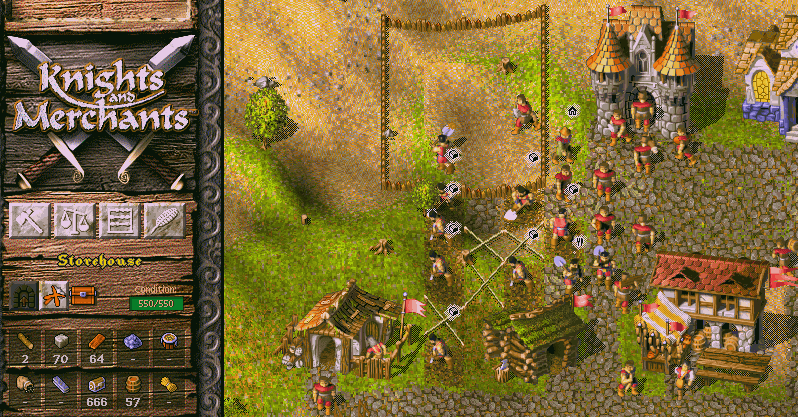
    A look at the Storehouse (which stores goods to be imported/exported) reveals all the possible resources in the game. Every material has a visual and a physical element, and must be transported via roads, and perhaps the most vital resource (food) limits the player’s total population/military count. In most other RTS games a player’s unit limit is either fixed or set by some building, and the resources are far simpler than KaM’s approach.

    Compared to the way the other games handle resources and population limit, KaM’s is a complete disaster. It is extremely indirect and is only informative to those who understand the way the game works. The more modern approach is very basic in comparison, and the information a player needs is readily available at all times. In addition to this, modern RTS games tend to have fewer resources to manage. Other games released prior to 2000 such as Settlers III and the original Command & Conquer also suffered from UI that would not bode well today because resources and unit caps were either hidden or it required the player to understand the language of that specific UI. KaM remains one of the most complex economies in RTS.

    The chart below is a small portion of a chart that demonstrates all possible resource paths available in the game. The most versatile resource, and the one that I still have trouble managing to this day, is corn (produced in a Farm, 25 on the chart).

    A farmer produces a single unit of corn (STR) and this single unit can go to one of three places: the Horse Stables (24), the Swinefarm (18), or the Windmill (26). But organic goods (horses, pigs, trees, grapes) take time to grow before they can be harvested and sent to be refined into other goods (cavalry, leather armor, sausage, lumber, wine). But there is yet another caveat: even before the player can begin producing these goods there are certain things that must be put in place, and we now circle back to the builder who must construct a farm, a windmill, and a bakery (each which costs a certain amount of lumber, stone, and a trained citizen) before a single loaf of bread is ready to eat. And each individual loaf of bread must be transported from the bakery to the storehouse. And this is the case for every single material in the game.


    Source/Full Chart: http://de.wikipedia.org/wiki/Knights_and_Merchants#Wirtschaftssystem

    The next key point to take from the economy is that the player has absolutely no control over the serfs who transport these materials. Serfs are coded in such a way that the instant a building produces a material the next available serf will take the shortest possible road to that building. Once he has procured the resource, he again takes the shortest possible road to the next building in need of that resource. Therefore the player cannot command serfs to take the next 100 units of corn to the windmill instead of the stables, but what the player can do instead is deny the delivery of wares to the stables. If the player wishes to micromanage his/her resources he must do so in an indirect manner. In conjunction with this inability to micromanage serfs the fact that every unit can collide with any other unit opens up many opportunities for gridlock especially in high-traffic areas (like storehouses), or areas near newly planned constructions. Furthermore, every citizen and military unit requires food from time to time, which adds another layer of complication to unit collision within towns. I cannot recall the amount of times I built a poorly laid out town, or forgot to build additional Storehouses only to have my entire town come to a complete stop because of severe gridlock, to which the only solution is wait for the frozen serfs to starve to death. I say this is the only solution but the other solution is last resort: destroying the Storehouse with all your goods in it. Unfortunately not only will it get rid of the gridlock, but it will also take everything inside, and all the goods currently being carried to the Storehouse. Either way the significance of collision will come up again later as I begin to conclude the section on Military.

    To conclude this section, the player cannot control the majority of the town. But a few of the things he/she can control include the production of citizens, military personnel, and war materials. These three images below are the overview of the Swinefarm, Sawmill, and Bakery. The only options a player has for these buildings are to cease providing needs, which halts production, and to allow reconstruction if damaged by the enemy. This is the case for the majority of the buildings in the game.

    These images below are the overview of the Weapons Workshop, Schoolhouse, and Armory Workshop, and this is where options really open up. In this case the player has far more control over how much these buildings consume and how much they create. Here the player has direct output (and can manipulate the input to some degree). The way the game stands: military goods are much more valuable because it requires the player's attention beyond the point of simply constructing the building. The player gets to choose the weapons he/she wants to produce as well as the quantity. Non-military buildings in comparison are just automated and binary: either they are producing goods or they are not, and for the most part the player can forget about these non-military buildings without having to constantly check to see if the Baker is still producing bread, or if the farmer is still harvesting corn. This particular idea of automation makes perfect sense regarding the way the rest of the game is constructed and it perhaps it also says something more considering the game was released prior to 2000. In 2015 this idea of automation might say even more.

    Although there are many more nuances I could cover regarding the game’s economy, I think this “succinct” version provides enough for the time being.

    Military

    Before I begin this section I must reiterate that I have become spoiled by modern RTS, and this repetition is necessary because by today’s standards the combat in KaM is very clunky and unresponsive and weak, yet I think there is some significance I can draw from it. Building a strong military takes a while because it requires the collection of various materials, which must then be refined in order to make the weapons and armor. And course all of these materials must also be transported around across town next to all other goods, and it is likely that gridlock can form outside the Barracks, especially when troops collide with serfs.

    Clunky is the word I chose to describe combat because there are numerous bizarre instances in which two melee units on opposing sides are standing adjacent to one another but they do not attack. There are also times when an enemy unit is attacking a player’s units, but the player’s unit remains idle—sometimes until it dies, without retaliating—and through all this the player cannot issue any further commands. Once a melee troop is in combat that group’s command bar grays out and no more orders can be issued, which means the only real way to circumvent this problem is to have multiple squads of military units. The problem with this “solution” is that there is no way to select multiple groups at the same time (no click+drag, no assigning hotkeys, no lassoing troops, et cetera). The only exception to this lack of control is when dealing with ranged units; the player always has control over archers even if they are under attack, which I suppose makes sense since they are not attacking enemy units adjacent to them, but this inconsistency seems odd to me.


    Click for full image and melee/ranged comparison.

    Even when I first played the game I wondered why units were locked into combat and why the player lost control of his/her military. Military units are the only kind that the player has direct control over. The player can issue an attack, a complete stop, formations, and so on, so why does the player lose complete control once in the heat of combat?

    In spite of how much time I’ve pondered this question I have only recently been able to come to an answer unrelated to the game’s programming: whether or not Joymania intended for this interpretation I can make the case that in warfare there is only so much control a general has over his/her troops—this idea works far better when considering this is medieval warfare. Eventually there is enough chaos on a battlefield that the general’s orders are drowned out by the sounds of warfare, and KaM seems to reflect that in some sense. There is also sufficient reason behind the immunity archers have to being locked in combat, which comes from the game’s manual:

    What is most striking is that the manual specifically regard Bowmen and Crossbowmen the most important tactical element. This is no secret to anyone who has studied military history or has played similar games, but in this case Joymania themselves suggested ranged units should be protected and stay further from the combat, and although the harsh sounds of warfare still reach the backline it is likely a general’s orders are more easily understood and retain control of his/her archers. This distance from direct combat, coupled with complete control is an idea that lines up perfectly with the developer’s view that archers are the most vital component of a strong army.

    I mentioned in the section regarding economy that collision was an element of the game, and the same is true of military units. To recap, all units collide with each other and this is especially problematic in high-traffic areas because it delays the delivery of goods and can sometimes even bring a city to a complete stop. The collision element is much more problematic because the player cannot take control of a serf to order him to go around the traffic jam, and every serf/hungry citizen on his way to the inn only makes the problem worse. The idea of collision, joined with the amount of maintenance and upkeep necessary for every individual leads me to my ultimate conclusion of this interpretation.

    One of the things that helped me reach this conclusion was to think of what it takes to keep one person alive. In Age of Empires II all that is necessary is a house, which increases the player’s maximum population an additional 5 people. Construction of a house requires 30 wood, so each villager “costs” a one-time payment of 6 wood in addition to the 50 food necessary to actually train the villager. After that the villager does not consume any further resources. Furthermore in AoEII villagers can carry multiple units of wood/food/et cetera, and they do not require roads that were laid out by a builder in order to travel from one place to another, thereby making them far more efficient than the serfs of KaM.

    In KaM, a serf must be trained in a Schoolhouse (I will avoid the cost of the Schoolhouse as I did with the Town Center of AoEII). Each civilian trained at the school house costs 1 Gold, which is produced at a Metallurgist’s (which costs 4 wood, 3 stone). To make Gold the Metallurgist requires Coal and Gold Ore (Coal Mine costs 4 wood, 5 stone to construct; Gold Mine costs 3 wood, 2 stone to construct). I will avoid the costs of Woodcutter, the Sawmill, and the Quarry for the sake of sanity, but these 6 buildings together cost a total of 21 wood, 17 stone, not including the stone necessary for each unit of road leading to each of these resources and the Storehouse. These are simply the construction costs, the amount of time that passes while all of these buildings are built and all the resources are gather should be about 10 to 15 minutes at this point. That is what it takes to create a serf. To keep him alive, the player must construct an inn (6W, 5S plus the stone for roads), and the inn must be stocked with food for the serf, the miners, the metallurgist and all the other tradesmen mentioned so far, in addition to the upcoming tradesmen who produce the food. The simplest food resource of Wine requires a Vineyard (4W, 3S plus stone for roads, plus wood for the actual vineyard, plus the time waiting for the grapes to grow, plus the time it takes for a serf to take the wine to the inn). Add to this entire equation unit collision transporting the wood/stone to the construction site, idle time between producing goods, and the player has spent about 30 minutes trying to create a very basic economy for a single serf.

    What would be crazier is to look at all the resources and time necessary to keep the most expensive military unit alive, including costs of mines, blacksmiths, stables, keeping all of these people fed and finally keeping the knight alive with food. And now having this understanding of the game, and using this mindset of costs/upkeep/maintenance is where my interpretation of the game finally comes to fruition.

    Conclusion/Interpretation

    Knights and Merchants is a game that highly values the individual, and embraces the idea of the individual. It takes a lot to keep a person alive, that includes an occupation, food, attention, and the amount of time someone spent to set that up for this person is invaluable. Collision is a fundamental, albeit often times undesirable thing; people will get in one another’s way from time to time and there will also be instances when it seems everyone just stops and we aren’t going anywhere because no one’s willing to budge an inch. We unintentionally run into one another and get in each other’s way because we’re all doing our own thing, and even though we may be on the same side we have these moments of gridlock when we freeze up and cease to do any good until we sacrifice something, even if it’s extremely valuable.

    It’s very easy to get lost in the chaos, amid all of the constantly moving pieces, and it’s also very easy to lose control. In spite of these difficulties it is crucial to have the most amount of control when it comes to choosing the next course of action and making a stand. There are so many resources and so much time and energy invested into every individual, but it’s very easy to forget. Stepping back and taking a good look at things is vital because it might provide more insight and lead to better “tactical” decisions.

    Lastly, I don’t know what to say about automation/the robots taking our jobs.


    Notes:These are the main things I wanted to cover on this game, but I could have also discussed other elements of the game such as KaM’s interpretation of Fog of War, try to feed troops on the move, et cetera.

    The Knights and Merchants Remake includes many awesome features making it more suitable for modern playing such as more Fast Forward options, zooming in/out of the map, and combat notifications on the minimap. It is totally worth taking a look at.


    Ludography

    Blizzard Entertainment. Starcraft II: Heart of the Swarm. Blizzard Entertainment, 2013. PC. OSX.

    Blue Byte Software. Die Siedler III. Blue Byte Software, 1998. PC.

    Electronic Arts Los Angeles. The Lord of the Rings: The Battle for Middle-Earth. EA Games/New Line Cinema, 2004. PC.

    Ensemble Studios/Hidden Path Entertainment. Age of Empires II: The Age of Kings (HD). Microsoft/Microsoft Game Studios, 1999/2013. PC, MacOS.

    Joymania Entertainment. Knights and Merchants: The Shattered Kingdom. Interactive Magic/Topware Interactive, 1998. PC, MacOS, MorphOS.

    Westwood Studios. Command & Conquer. Electronic Arts/Virgin Interactive, 1995. PC, MacOS, various.

    Seoul of the World

    The Seoul of the world will watch.
    The Seoul of the world will chant.
    The Seoul of the world will cheer.
    The Seoul of the world will wait.
    The Seoul of the world will roar.

    Ten young have risen to the summit,
    Ten whose fates now rest
    In their own hands,
    Hands that've carried them this far.
    In spite of resistance
    And burdens
    And the weight of success,
    Ten agile minds will face off.
    And at the mecca of esports
    The Seoul of the world will watch.

    In this corner:
    The sister team at last victorious,
    A victory bittersweet
    That leaves behind a dented Deft,
    A Spirit crushed,
    A silenced Heart,
    And a fallen general surrenders command.
    Yet against all odds White bests Blue
    With the vicious, sinister-smile Imp
    Who broke the Piglet's back,
    White whose Mata pushes back the darkness
    And sentences death with precision.
    A PawN promoted now leads the charge
    And at the mecca of esports
    The Seoul of the world will chant.

    And in this corner:
    An amalgam built to challenge the best,
    A royal gamble who have once more denied kin
    From laying eyes upon the mountaintop.
    Here comes the prodigy with a second chance
    The Uzi that humbles Imp
    With energy raw and unmatched.
    Here too is the unseen inSec
    Who in few, rapid seconds inspires many
    Who are worlds apart.
    Even with meager earnings
    These five always fight to the death,
    No regard for those who impede.
    These tenacious will have much to prove
    And at the mecca of esports
    The Seoul of the world will cheer.

    Midfield will be silent,
    Empty,
    Quiet,
    Still.
    But soon,
    Soon they will congregate
    While patience quickly wanes.
    And at the mecca of esports
    The Seoul of the world will wait.

    Mental warfare within our Seoul will test years of work,
    And the cries of our Seoul will follow.
    Brutal, bloody fights will break,
    And raw energy will drive competitors forward.
    Here every second will matter,
    Here every decision will matter,
    Here every mistake will matter.
    Ten minds, the best of their kind,
    Will play for millions,
    But five will raise a cup,
    And at the mecca of esports
    The Seoul of the world will roar.

    Practice 10.9.2014

    No Man's Land v0.1
    What do you do,
    They ask,
    For a living?
    But
    They forget
    Our generation
    Has no living.

    Last Man Standing v0.1
    I see the last apple.
    It is all that remains.
    It is within my grasp, and I have an angry stomach.
    But an old hand taps the apple,
    And it dissolves into sand,
    Lost in the desert.
    All I can do is starve.
    So I starve.

    Today's the Day v0.1
    Today's the day I finally do it.
    I've thought on it long enough,
    So today's the day, the day
    I close my eyes for good.
    I've endured enough,
    I've cried enough,
    I've died enough,
    To endure this any longer.
    Once the deed is done:
    No more torment or despair
    Or pain or fear.
    Today's the day I finally get some sleep.
    But I have no coffee left.
    Damn it.
    Oh well, fuck it.
    I'm overworked and underpaid anyway.
    Who needs a job?
    I'd rather be happy.

    The Storm's Fury

    Once more I find myself upon this rift,
    Summoned to fight a war for which I do not care.
    But then I feel a gentle blowing breeze
    That whispers, softly, calmly, into my ears.
    Whan Zephirus eek with his sweete breeth,
    Inspirèd hath in every holt and heeth,
    The leaves and bushes rustled and swayed to the air,
    And then she appeared to me.
    And then I knew I was not alone,
    Walking the old hills of this rift
    With the beautiful gentle goddess by my side.
    We speed through space,
    Windforce hastens my stride,
    A tailwind lifting my feet with ease,
    And we are first upon the battlefield.

    Gently she glides, a commanding aura about her
    Carefully keeping our foes at bay.
    And she is not clumsy like I,
    For she does not collide with the endless combatants.
    A rapid change of heart-our foes dash forward
    And I am in their sights.
    So my time has come, has it?
    But the gentle goddess casts Zephirus,
    Slowing their advance,
    And granting us chance to escape,
    Windforce hastening my stride,
    A tailwind lifting my feet with ease.

    While on the retreat, our foes chase.
    They fire projectiles,
    But the gentle goddess waves her staff
    And the air shields me, staring tempests in the eyes
    While a soothing wind whispers that I am safe.
    The gentle winds slowly build,
    Build, build,
    And a great tornado lunges forward,
    Knocking our foes airborne.
    My chance to strike is now,
    I, in the eye of the storm,
    Shielded and empowered,
    Our enemies in chaotic disarray,
    And together we strike!
    Again we cheat death,
    With Zephirus on our side,
    And howling gales impairing their offensive line.
    All the while
    Windforce hastens my stride,
    And a tailwind lifts my feet with ease.

    A storm approaches,
    And we find ourselves surrounded.
    Surely this must be the end of the line.
    But once more the elemental wind finds a way,
    The gentle winds turn violent,
    And the once-gentle goddess summons turbulent winds,
    The air gyrates rapidly
    And a whirling maelstrom roars,
    The goddess calls forth nature
    And a great monsoon blows away our foes,
    But in the eye of the storm,
    I again find opportunity to strike,
    And at long last the fight comes to an end.
    They made her furious and impatient,
    And she quickly turned violent, like the winds.
    Now together we've survived,
    With the gentle goddess by my side,
    Windforce hastening my stride,
    A tailwind lifting my feet with ease.

    And they thought it was just a harmless breeze.


    Where Legends Gather
    Change logs
    Version/BuildDateChange(s)
    v Release v
    v1.0
    Live Version
    July 28, 2014-
    v Alpha v
    v0.4July 28, 2014-
    v0.3July 10, 2014-
    v0.2January 13, 2014-
    v0.1January 13, 2014-

    The Harbinger of Doom

    In the woods
    Life creeps and crawls and squirms and clicks,
    With the many-legged bugs and beasts
    That stomp the ground, to snap and crack all twigs and sticks.
    Rivers rush and gush and shush and push
    While the birds chirp and the crickets sing.
    Beware, however, beware sudden silence:
    Should the sounds drown out,
    Should nature's tune go mute
    And the ancient trees no more moan and creak,
    Should your eyes be drawn to distant shadows,
    Beware, beware the messenger.

    If all wildlife
    Dare not make a sound,
    And airborne dread begin to weigh you down,
    Look around for emerald lights
    Attached to a thin,
    Distant,
    Figure,
    Standing still in the dark.
    If your blood, warm,
    Pulls outward in all directions,
    And the cool air slaps against it,
    While a trickle crawls up your spine,
    The messenger is out for you.
    A crow takes flight,
    A dark wind that bounces nearer, nearer,
    From branch to branch,
    Eyes intently locked with yours,
    And calls:
    Caw,
    Caw,
    Caw,
    Its eerie cry sure to silence you.
    Still the distant emerald lights
    Slice through the air,
    Like scythe to a harvest.
    Beware,
    For the messenger draws near.

    The airborne dread turns liquid,
    Heavier than before,
    Rains down,
    Makes splashes to your steps
    And seeps into your soles.
    The dread lingers and grows
    Yet no matter where you go
    The distant figure closes in,
    With a tap,
    Tap,
    Tap-tap
    Of sticks against the ground.
    Now the messenger of brittle sticks
    Is attached to you,
    With a bond that drains your strength,
    Steals your life,
    And further brings your doom.

    I've heard of only few who've lived,
    And all've said the same:
    The dread persists,
    But now in physical form.
    The figure from the shadows jumps to you
    And murder, crowstorm—
    Crows circle overhead
    Crows cry, caw, call,
    Circling overhead,
    All the while terrified
    Petrified
    Frozen
    Stunned
    With fear
    So immense the heart plummets
    Into worthlessness.
    The emerald eyes you see belong to nothing
    Of this world.
    Those who've lived, live by luck.
    The weakened scarecrow surely drained enough
    To claim the next victim to walk and tread
    That twisted treeline.
    But no one dares set foot in there again.
    Not us, oh no, not us,
    Only those brave enough,
    Those we call
    Legends.


    Where Legends Gather
    Change logs
    Version/BuildDateChange(s)
    v Release v
    v1.0
    Live Version
    July 22, 2014-
    v Alpha v
    v0.3July 22, 2014-
    v0.2July 15, 2014-
    v0.1July 15, 2014-